
A synchronous motor operating as a generator. It is a commonly used alternating current generator. In modern power industry, it is widely used in hydropower generation, thermal power generation, nuclear power generation, and diesel engine power generation. Since synchronous generators generally use direct current excitation, when they operate independently, the excitation current can be adjusted to conveniently regulate the generator’s voltage. If connected to the power grid for operation, since the voltage is determined by the grid and cannot be changed, adjusting the excitation current results in regulating the power factor and reactive power of the motor.
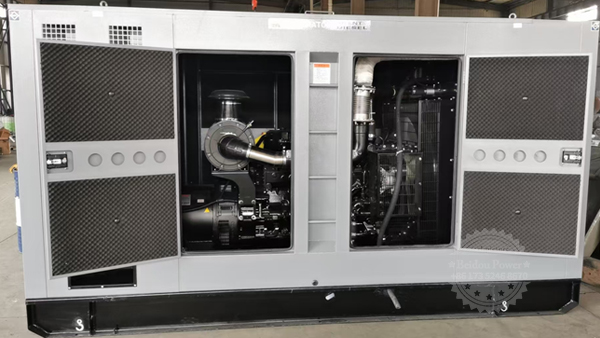
The stator and rotor structure of a synchronous generator are the same as those of a synchronous motor. Generally, they adopt a three-phase form, except that the armature winding in some small-sized synchronous generators uses a single-phase form.
Working characteristics
The main performance characteristics of a synchronous generator are the no-load characteristics and the load operation characteristics. These characteristics are important references for users when selecting a generator.
No-load characteristics
When the generator is not connected to a load, the armature current is zero, which is called no-load operation. At this time, the three-phase windings of the stator of the motor only generate the no-load electromotive force E0 (three-phase symmetrical) due to the excitation current If, and its magnitude increases with the increase of If. However, due to the saturation phenomenon of the magnetic circuit core of the motor, the two are not in a direct proportion. The curve reflecting the relationship between the no-load electromotive force E0 and the excitation current If is called the no-load characteristic of the synchronous generator.
Armature reaction
When the generator is connected to a symmetrical load, the three-phase current in the armature winding will generate another rotating magnetic field, which is called the armature reaction magnetic field. Its rotational speed is exactly the same as the rotor’s rotational speed, and they rotate synchronously.
The armature reaction magnetic field of the synchronous generator and the rotor excitation magnetic field can be approximately regarded as distributed according to a sine law. The spatial phase difference between them depends on the time phase difference between the no-load electromotive force E0 and the armature current I. The armature reaction magnetic field is also related to the load condition. When the generator’s load is inductive, the armature reaction magnetic field has a demagnetizing effect, causing the generator’s voltage to decrease; when the load is capacitive, the armature reaction magnetic field has a magnetizing effect, causing the generator’s output voltage to increase.
Load operation characteristics
Mainly refer to the external characteristics and adjustment characteristics. The external characteristics are the relationship between the generator’s terminal voltage U and the load current I when the speed is at the rated value, the excitation current and the load power factor are constant. The adjustment characteristics are the relationship between the excitation current If and the load current I when the speed and the terminal voltage are at the rated value and the load power factor is constant, as shown in Figure 3. Figure 2 also shows the situations of resistive, capacitive and inductive loads. Due to the different effects of the armature reaction magnetic field, the curves of the three are also different. In the external characteristics, the degree of voltage change from no-load to the rated load is called the voltage change rate △U, which is commonly expressed as a percentage.
The voltage change rate of the synchronous generator is approximately 20% to 40%. Industrial and household loads generally require the voltage to remain basically unchanged. Therefore, as the load current increases, the excitation current must be adjusted accordingly. 3 types of adjustment characteristics for different load properties. Although the trend of the adjustment characteristics changes opposite to the external characteristics, for inductive and purely resistive loads, it is rising, while in capacitive loads, it is generally decreasing.
Structure and classification
The structure of a synchronous generator is classified into high-speed and low (medium) speed types according to its speed. The former is mostly used in thermal power plants and nuclear power plants; the latter is mostly linked with low-speed water turbines or diesel engines. In terms of structure, high-speed synchronous generators mostly use hidden-pole rotors, while low (medium) speed synchronous generators mostly use convex-pole rotors.
High-speed synchronous generator
Since most generators are coupled with the prime mover coaxially, thermal power plants use high-speed steam turbines as prime movers, so steam turbine generators usually use high-speed 2-pole motors, with a speed reaching 3000 revolutions per minute (at a grid frequency of 60 Hz, it is 3600 revolutions per minute). Nuclear power plants mostly use 4-pole motors, with a speed of 1500 revolutions per minute (when the grid frequency is 60 Hz, it is 1800 revolutions per minute). To meet the requirements of high speed and high power, the high-speed synchronous generator adopts the following structural features: firstly, it uses a shunt rotor; secondly, it is equipped with a dedicated cooling system.
For more questions about the generator set, please call the Beidou Power team. More than ten years of professional production and sales of power generation equipment experience, more professional engineer team to serve you, choose Beidou power is to choose rest assured, welcome on-site factory inspection.
Post time: Jan-22-2026